Making his 3rd consecutive Stanley Cup Final appearance, Matthew Tkachuk has undoubtedly made a name for himself as an elite power forward. But Matthew isn’t the only Tkachuk to make a name for himself in the NHL – and we’re not just talking about his all-star brother Brady.
Keith Tkachuk, father of Matthew and Brady, started the Tkachuk name legacy as a player and a coach. From hits to 50-goal seasons, Keith helped define an entire era of physical, dominant hockey.
Let’s take a look at the role of a forward has evolved from father to son — not just in stats, but in playing style, leadership, and the evolution of the power forward role from the 1990s to the 2020s.
Keith Tkachuk: The Classic Power Forward
Keith Tkachuk is a prime example of a classic power forward, in his 18 seasons in the NHL, Tkachuk has had an impressive career. Drafted 19th by the Winnipeg Jets in 1990, Keith played during the peak of the “heavy” game era.
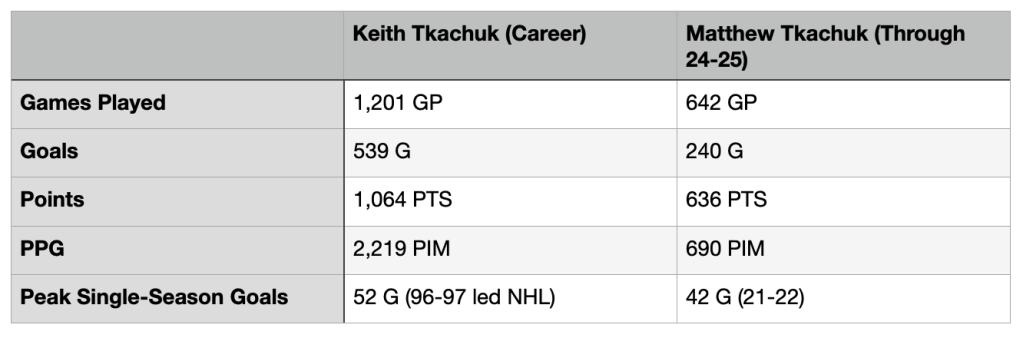
- Career stats: 1,201 GP, 538 G, 1,065 PTS, 2,219 PIM
- Peak season: 1996–97 – 52 goals (led the NHL), 228 PIM
- Captained the Coyotes and earned five All-Star selections
Keith was a blueprint for a traditional power forward – someone who could score 40+ goals a season and drop the gloves over and over.
Matthew Tkachuk: The Modern Evolution
Matthew Tkachuk, drafted 6 overall by the Calgary Flames in 2016, has no doubt carried on the Tkachuk legacy name. Playing 6 seasons with the Flames, he was traded to the Florida Panthers in 2022. During his 9 NHL Seasons, Matthew Tkachuk has made 3 post season appearances – winning the Stanley cup in the 2023-24 season.
- Career stats (through 2025): 642 GP, 240 G, 636 PTS, 690 PIM
- Breakout year: 2022–23 – 40 G, 109 PTS, 123 PIM
- Playoff performance: Key driver in Florida’s 2023–24 Stanley Cup win
Tkachuk has made a name for himself with his elite hockey IQ, offensive creativity, and agitating opponents. He thrives in a speed-and-skill era where drawing penalties and puck possession matter more. Although he still throws big hits and plays a very physical game, Tkachuk is an excellent playmaker racking up high assist totals, especially in the playoffs.
Then vs. Now: Key Differences in Their Eras
Pace of play: Keith Tkachuk played in a slower, grinding era of the league, whereas Matthew Tkachuk has adapted to the current faster paced era of the league.
Physicality: Fighting was a bigger part of Keith’s game; Matthew relies on agitating other teams more than drops gloves.
Role on team: Keith was a pure scorer and enforcer hybrid, yet Matthew is a top-line play maker.
Media: Keith kept a low profile off the ice. Matthew plays a bigger role in branding and fan engagement now that the NHL has leaned more into personality players. Matthew’s appearance in the 4 Nations landed him media opportunities like appearing on The Tonight Show Starring Jimmy Fallon.
Stats Snapshot: Production Comparison
Intangibles and Leadership
Both Tkachuks have worn letters — Keith as captain in Phoenix, and Matthew as alternate captain in both Calgary and Florida.
- Keith led with toughness, production, and old-school presence.
- Matthew leads with passion, creativity, and an ability to emotionally elevate his team, especially in high-stakes playoff moments.
Two Eras, One Legacy
Despite playing in radically different eras of hockey, both Keith and Matthew define what it means to be tough, skilled, and impactful. Keith paved the way for players like Matthew, who now dominate the game in a smarter, faster way. The Tkachuk name remains synonymous with playoff passion, leadership, and chaos — just redefined for a new generation.
 The Hockey Edit
Leave a comment